

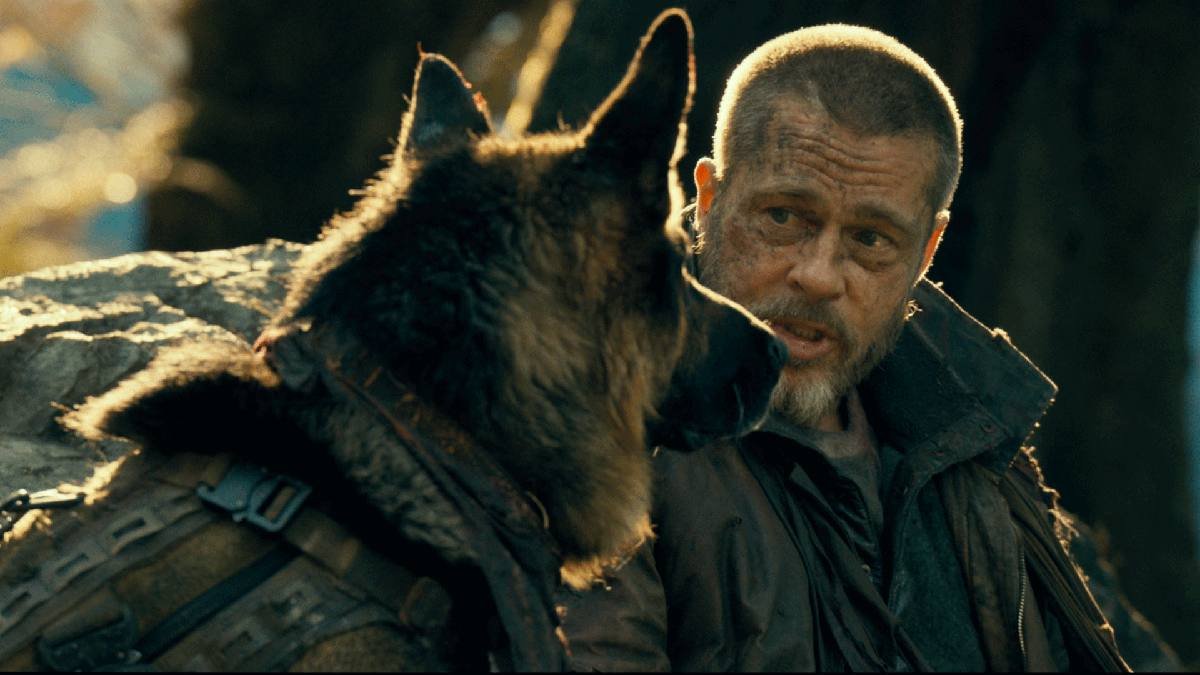
David Ayer and Brad Pitt have worked together before on the World War II combat film Fury. While Ayer is best known for loud, fast action thrillers, he and Pitt now take a wide swing at something not wholly traditional to either of their staple genres.
Heart of the Beast is a story of the deeply shared connection between a man and a dog trying to survive. The title sounds like it was made for Ayer’s usual crowd; while it could ultimately appeal to anyone the film has a softer center, one that should speak to dog lovers, dog owners, and anyone who can feel for another living thing.
Pitt plays James Belmont, a retired Special Forces Command Major. He and his combat dog, Odin, both live with PTSD from their time in military service. They travel to remote Alaska together, but their trip ends in a crash and they are left with no way to get around with the nearest sign of civilization being 58 miles away. Both man and dog with quiet determination set out on foot through the Alaskan wild, exposed to the dangers of nature at every step.
What Works ✅
An Alaskan-inspired Score and how it is used: The score blends Alaskan Inuit vocalizations with minimal use of musical instruments. How and when it is used in the film is what makes it outstanding just as it does the same for the scenes it is used in. When it comes on it lifts the moment and gives the landscape an almost otherworldly weight.
In the quiet stretches, the score mixed with the natural sounds of the scene from the heavy breathing of Odin, sound from dangers of the landscape with Belmont’s laughs and cries give an unsettled feeling. The thin score beneath these sounds sharpens whatever the scene is meant to make us feel.
Balance Between the Pace and Tension: Heart of the Beast keeps one gentle and thoughtful pace from start to finish. Yet each part of the story still gets its own mood and its own kind of tension.
The first act, which introduces Belmont and Odin, moves at an unhurried pace. It has quiet and somber moments that let us sit with the pair. Once they are stranded, the pace holds, but tension begins to creep in.
From there their journey moves between slow, reflective stretches and sudden bursts of danger, giving the sense that danger is unpredictable.
Man and Dog Relationship: The approach to the man and dog relationship balances how engaging what happens on screen. Over a series of harrowing survival moments, the film shows how much Belmont and Odin trust and lean on one another with neither needing the other more.
At different points, each nurses the other back from the edge, each urges the other not to give up, and each shields the other from deadly danger. These moments play to each one’s own strengths and give the story an emotional pull.
What Doesn’t Work ❌
The Flashbacks are interruptive and Redundant: Select scenes featuring flashbacks that show both the traumatic and the bonding moments Belmont and Odin shared during military service. The scenes have a textured look, with sepia-like tones and fast, jumpy editing that pull you out of the film’s flow.
Most of these moments tell us very little about what those moments meant to the characters, whether the horrors of war or the trauma left behind, and mostly come off as generic.
The Opening Scene Affects the Overall Suspense: The first scene is set a week after Belmont and Odin begin their journey. Its inclusion and how it is presented hints at the date of Odin and Belmont. That weakens the ending and drains the suspense and dangers the film tries to build. This foreshadowing also affects the sentimental weight of J.K. Simmons’ character, Watkins, making him seem like an unnecessary addition.
A Familiar Survival Story: Heart of the Beast takes the classic survival story of a person and an animal companion against nature, and makes one welcome change by placing it in the Alaskan wild. The dangers the pair face, though, are familiar ones and are not staged in a way that strongly grips you or feels memorably different.
⚖️ Verdict: 2.5/5
Heart of the Beast brings a gentle change of pace and tone to a high-stakes survival story. Brad Pitt gives a sincere performance, and Uber, the dog who plays Odin, is emotively captured on screen. David Ayer’s quieter, more somber take is a welcome surprise, with emotional notes that are well placed and reach the audience.
However, these strengths, the film’s staying power, and some of its choices may take some getting used to, especially for viewers who are drawn to what the film could have been.
