

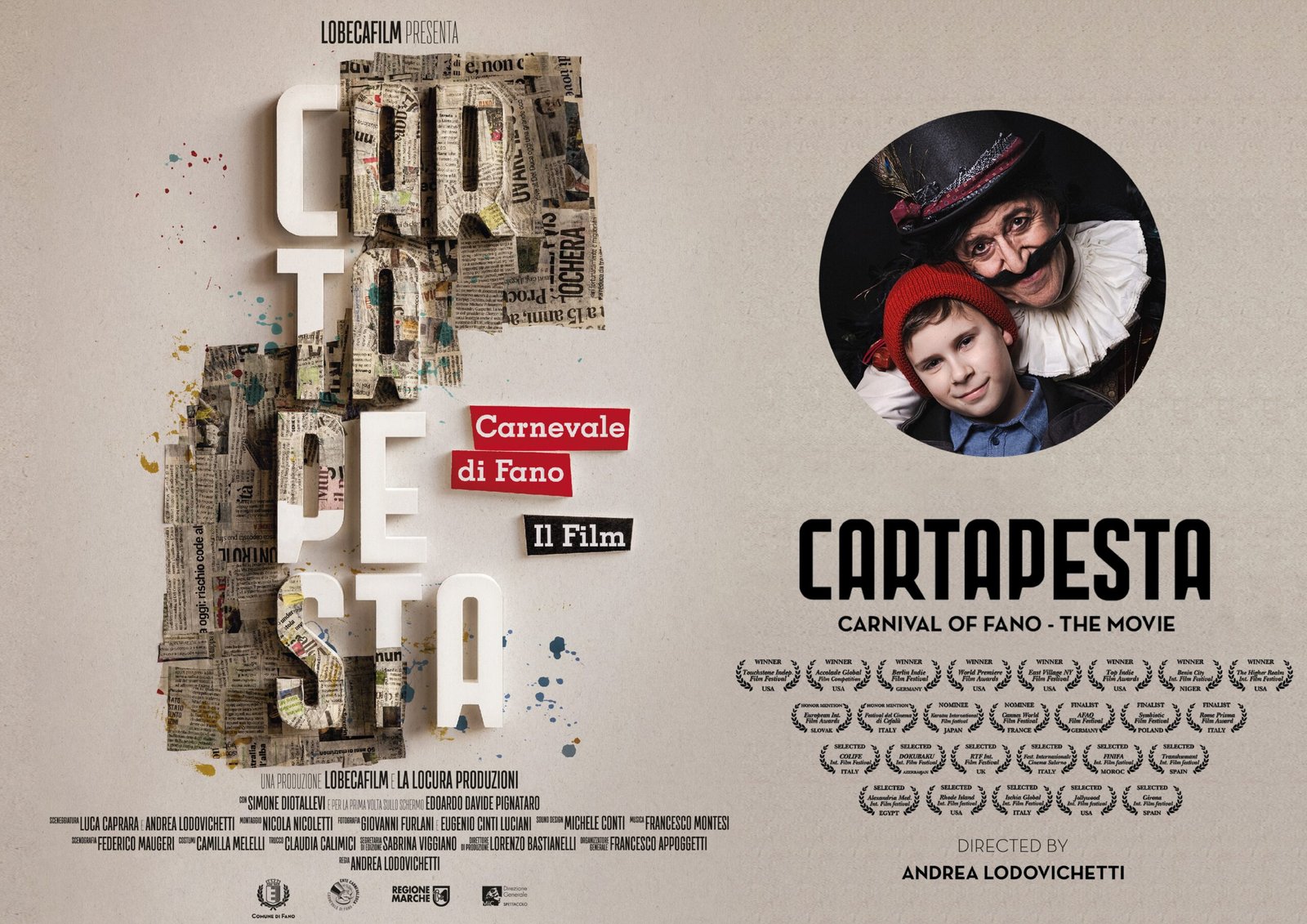
Beyond the quiet streets of Fano, Italy, lies a festival that fills the city with beautiful noise, brings its people closer to their roots, and strengthens a sense of community that has endured for generations. Every year, the Carnival of Fano transforms the city into a lively celebration of colour, creativity, and tradition.
In his documentary, filmmaker Andrea Lodovichetti explores this centuries-old tradition through the artisans and the hard work behind its enormous papier-mâché figures, revealing a side of the celebration that most spectators never get to see.
The Italian filmmaker turns his attention to a celebration dating back to 1347 in Cartapesta: Carnevale di Fano – Il Film. However, rather than making a conventional documentary about the history of the carnival or concentrating entirely on its colourful public celebrations, Lodovichetti looks behind the spectacle to explore the people, craftsmanship and memories that keep the tradition alive.
Rediscovering a Tradition Beyond the Streets
Growing up in Fano, Lodovichetti was already familiar with the carnival. He knew the music, the enormous floats and the excitement that came with the annual celebration. What he had not fully considered was everything that happened before the festivities reached the streets.
Returning to his hometown with a camera allowed him to enter the workshops and observe the work that takes place during the months leading up to the parade.
His experiences outside Fano had also changed the way he approached the project. After studying at Rome’s Centro Sperimentale di Cinematografia, Italy’s National School of Film, and working on film sets, including with Paolo Sorrentino, he spent time in New York and Los Angeles. Yet, returning home did not necessarily mean he understood his hometown better.
“Quite the opposite: I realised how many things I’d taken for granted,” Lodovichetti said in an interview with LikeCine.
Inside the carnival warehouses, he encountered artisans deciding on the proportions, movement, and expressions of figures that would eventually tower above the crowds. The process involved more than simply constructing elaborate decorations.
“There’s engineering in those places, as well as an extraordinary freedom to invent. And a great deal of patience,” he stated.
That patience became central to his understanding of the tradition. He wanted audiences to see the transformation of paper into something that could command attention during the carnival, while recognising the knowledge and experience behind every creation.

“The Carnival is documented in Fano as far back as 1347. It’s an extraordinary history, but the date wasn’t the heart of my film,” Lodovichetti explains. “I wanted to get close enough to the work for a spectator to sense the dust in the air and the light on the paper before it becomes a character.”
A Story Told Through Memory and Discovery
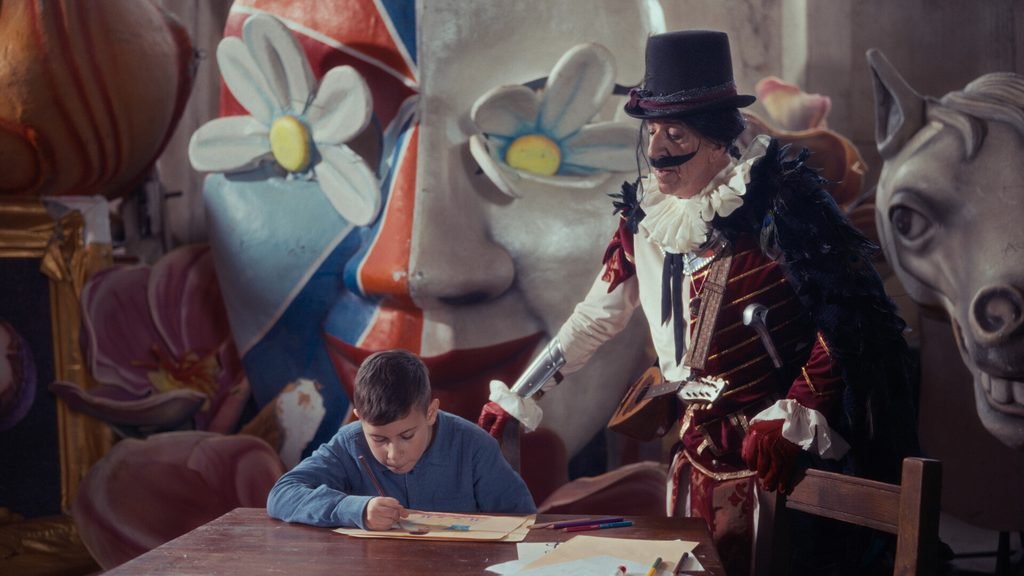
Rather than following a straightforward historical timeline, Cartapesta combines archival material with a narrative encounter between the Vulón (the carnival’s masked figure being portrayed as a character in the documentary) and a child who knows nothing about the carnival.
The decision gives the documentary a way to introduce the tradition without assuming that every viewer already understands its history or significance. The child approaches the celebration with curiosity, while the Vulón brings humour and mischief into their interactions.
Lodovichetti explains that he wanted to avoid making a documentary in which historical information simply follows one event after another.
“I love archives. But I didn’t want to make a film in which one historical fact politely follows another until we reach the present day. That’s not how I experience memory.”
Instead, his intent is to capture how memories emerge through familiar sounds, images, and experiences. Working with Luca Caprara on the screenplay, Lodovichetti developed the relationship between the Vulón and the child to carry this idea throughout the film.
“The boy doesn’t know what he’s looking at; he has no reason to pretend otherwise,” he says. “The Vulón, on the other hand, is a splendidly immodest fellow, a Carnival mask who takes himself rather seriously while making fun of everyone else.”
Their relationship allows the documentary to move between curiosity, humour, and affection. Beneath those interactions, however, sits a bigger question about how traditions survive.
As Lodovichetti puts it, “We can tell him the history. We can’t order him to love it. We have to let him discover it.”
Archival images collected from people in Fano also contribute to this exploration. These were not necessarily photographs originally taken for historical documentation. Many were simply personal records of ordinary celebrations, preserved by people who wanted to remember particular moments.
By placing these images alongside present-day footage, the documentary connects different generations through the unchanged lens of the people.
The People Behind the Spectacle
One of the most interesting aspects of making Cartapesta was gaining access to the people who bring the carnival to life. For Lodovichetti, being from Fano helped, but familiarity alone was not enough to establish trust.
“You begin by accepting that the workshop isn’t your set,” he explains. The artisans had deadlines, problems to solve, and work to complete. They could not simply stop what they were doing whenever the director needed another shot.
Instead, Lodovichetti had to observe, listen, and recognise when to step aside. Some of the moments that affected him the most were not necessarily the spectacular ones.
“From the tractor-drawn platforms you see these astonishing figures floating above the crowd. In the workshops you see how stubbornly human they are: mistakes, fatigue, arguments, affection for the work.”
Those experiences also changed how much importance he placed on the parade itself. The public celebration might last only a few hours, but it represents months of effort by the people preparing it.
“I didn’t want their work to become a colourful introduction to the ‘real’ event. It was already an event, even with the doors closed and no audience present,” he says.
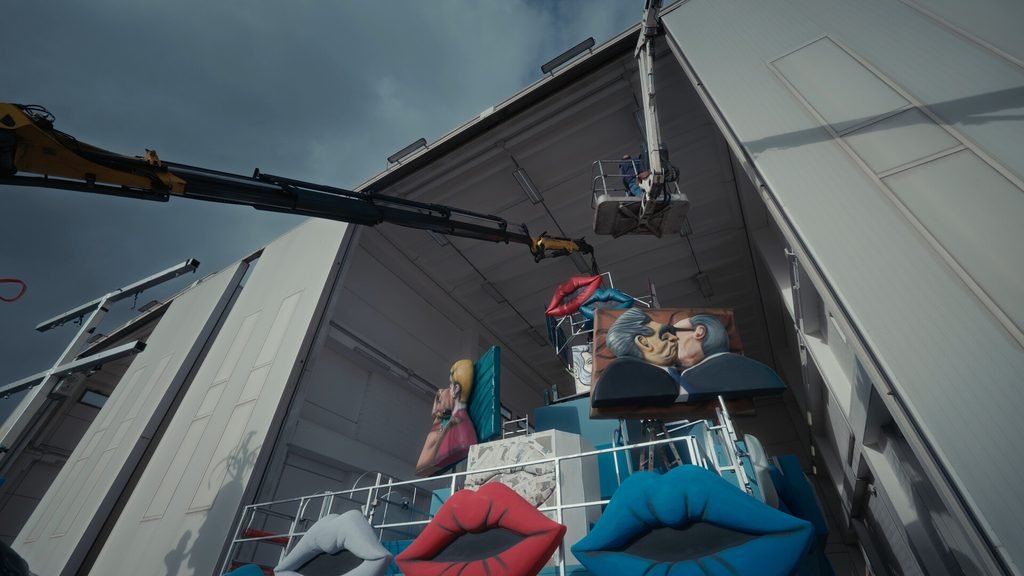
Capturing both sides of the celebration also presented technical challenges. Filming the workshops required patience and observation, while the carnival streets demanded constant readiness. The movement of floats, music, crowds, and unexpected moments made it impossible to control everything.
“The sound of a street packed with people is almost physical; the concentration of someone working with paper and glue can be extraordinarily quiet,” Lodovichetti explains. “Both had to be present.”
He also had to find a balance between the different visual and audio elements. Giovanni Furlani and Eugenio Cinti Luciani handled cinematography, with Nicola Nicoletti on editing, Francesco Montesi composing the music, and Michele Conti handling sound design.
Bringing the Carnival to a Wider Audience
For all its local history and cultural references, Cartapesta is not intended only for people familiar with Fano. Lodovichetti hopes international audiences can enjoy the energy and unusual characters before discovering the stories behind it.
“There’s another Carnival, almost hidden from view, that starts long before the music. It smells of glue and damp paper,” he says. “They make something magnificent from a material you can tear with your fingers.”
The contrast between fragile material and generations of craftsmanship is one of the documentary’s most compelling ideas. The figures created for the carnival may eventually be replaced, but the knowledge and dedication behind them continue to shape the tradition.
The film has already travelled beyond its hometown, receiving selections, awards and invitations to screenings at festivals around the world. For Lodovichetti, that international response is particularly meaningful because audiences unfamiliar with Fano must discover the celebration through the documentary itself.
He hopes viewers will leave curious about the artisans and the people behind the figures, rather than simply remembering the spectacle.
“I don’t need an audience to share our customs. I’d like them to understand why we care about them,” he says.
For more information about the documentary and its journey, visit Andrea Lodovichetti’s official website and the official Cartapesta film website.
