

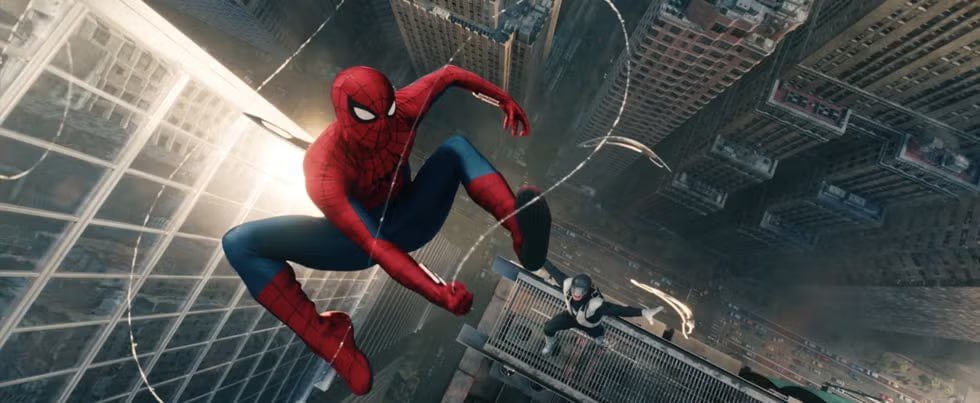
High school is over, and this fourth chapter of Peter Parker’s story makes sure both the character and the audience feel it. Where the previous MCU Spider-Man films were full of high-tech, larger-than-life events, and high-school naivety, breezy with high-energy web-slinging adventures, Brand New Day keeps Spidey in the neighbourhood for the first time and fully merges the man with the mask.
The exotic scaffolding we have come to be familiar with when seeing Tom Holland’s Spider-Man on screen is replaced with a more responsible Peter Parker. Destin Daniel Cretton’s direction with this new Spider-Man removes the godfather-figures who once propped Peter up, and the weight of consequences from choices made and left unmade.
Years after Doctor Strange erased Peter Parker from everyone’s memory to resolve the chaos of No Way Home, Peter has been living almost entirely as Spider-Man. His friends moved on to college while he stayed behind in the neighbourhood, going deeper into crime-fighting and catching glimpses of their lives only through social media.
Now Ned and MJ are back in the city, and Peter is forced to face reconnecting with them even as the grief that separated them in the first place sits unresolved and fresh between them.
At the same time, he is being outpaced by a threat he cannot seem to get ahead of. This is an adversary moving through the city with a precision that suggests they are not acting on impulse. And layered over all of this is a biological change within Peter himself, his arachnid genes intensifying in ways that are destabilizing the one life he thought he had under control.
What Works ✅
A Grounded Character Study
There is no world-ending threat, no city-wide catastrophe being held at bay. Instead, the film keeps the conflict focused on the man behind the mask. The scale is deliberately pulled back, and the source of tension is not a straightforward villain but a complicated, wounded figure acting on private grief. This gives the film space to explore Peter Parker and Spider-Man as one tangled identity rather than keeping them separate.
Peter’s insecurities from growing into the harsh reality of adulthood sit close to the surface throughout. He lives as a loner and deflects anything personal during conversations with his police contact. Peter guards his secret identity too tightly to himself. The ease with which he once trusted people with his secret identity cost him everything he had, and that history shapes every interaction in the film without ever being stated outright.
Peter is no longer the polite, eager-to-please hero of the earlier films. He has lived enough to know he does not have to keep softening himself to stay in people’s good graces.
MJ’s character stands out in particular. She has grown visibly from the quietly strange, emotionally guarded teenager of the earlier films into a warm, grounded adult who carries a kind of moral clarity. When the full picture of what she unknowingly walked into comes forward, she handles it with a composure that feels earned.
MJ’s insight not to build a power-suppressing device to control Jean Grey reflects something the earlier version of her character was working toward all along — a young woman who never trusted systems of control and has grown into an adult who understands why.
The Consistency Between Tone and Pacing
The film moves like a slow-burn drama. The tone is consistently bleak, but it is interwoven with moments of natural humour that come from the personalities of the characters rather than from comic relief inserted into the script. While the weight never fully lifts, the execution allows the film to breathe.
What makes the bleak adult dramatic tone work so effectively is how it sits alongside the superhero elements rather than competing with them. The film does not pause the drama for action and then resume it afterward. The tension hovers around it and into every sequence.
The most notable example of this is Spider-Man’s swing through the air with MJ after a particularly heavy moment. The quiet and somber swing back to her apartment allows the preceding scene to settle in without interrupting the pacing. His muttered control mantra, “webstop,” during that same sequence carries his biological struggle right into the emotional one.
Spider-Man’s bickering partnership with Frank Castle works in the same way. The pressure of everything unresolved between them follows them into every attempt to stop a threat and every rare moment of reluctant warmth between them.
The Mutation is Fun to Watch
The intensification of Peter’s arachnid biology does more than add a physical complication. It mirrors his psychological state directly. It’s also pretty cool to just watch.
As Peter retreats further from his identity as a person and doubles down on being Spider-Man, his biology follows. The mutation produces something grittier and less polished in his webs, movement, and appearance. What we get is a rougher and more unsettled version of the smooth superhero closely related to the source material.
Action Sequences and Camerawork
For a character who has appeared in nine live-action films, it would be reasonable to expect that everything that can be done with web-swinging has already been done.
Director Destin Daniel Cretton finds new ground anyway, using extreme close-up and point-of-view camera work that gets intimate with Spider-Man in a way no previous film has. The camera moves with him rather than tracking him from a distance.
The film’s most memorable fight sequence subverts the expectation that Spider-Man’s agility makes him untouchable. He is overwhelmed by highly trained fighters who are not enhanced in any obvious way, people who might easily be underestimated at first glance.
What follows is a sequence in which Spider-Man integrates his swings and movement with a martial arts sensibility, using the environment and his webs to pull, push, and reposition mid-air like a natural evolution.
The depiction of telepathic possession is handled with equal care. The physical expressions of those under Jean Grey’s control, the way they carry themselves, the quality of their voice, all of it matches the level of control she has over them and makes the ability feel genuine and awe-inspiring.
Where It Falls Short ❌
No Real Sense of Threat
The film consciously steps away from the straightforward villain, and that instinct is defensible. What it gives us instead is a wounded figure going down the wrong path and a corporate figure operating from behind the scenes. The problem is that neither is explored in a way that makes them feel dangerous.
The audience gets very little glimpse of what the corporate figure is actually doing or planning, so it barely registers as a threat and simply reads as morally empty.
Jean Grey is more interesting, but the film is so cautious about making her feel antagonistic that it avoids examining what is actually driving her. Her loneliness and alienation are established but never followed through to show just how far her nefarious actions can go.
An Incomplete Story
The mutation arc is the clearest example of something the film raises and then abandons. Over an hour of the film is spent watching Peter struggle with intensifying biological changes that are altering what he is capable of and threatening the control he has built his life around.
That struggle ends with an abrupt decision that appears with no real build-up and resolves everything almost immediately.
Questions that the film raises about Peter choosing connection over isolation, about accepting what he is becoming rather than fighting it, are touched on and then left in a state that makes it seem like it’s being held for the next film.
We never see Peter genuinely wrestle with the choice to stop being alone. The dramatic groundwork that should make his eventual shift to be earned is not laid. The resolution arrives because the film needs it to, not because the character reached for it.
⚖️ Verdict: 4/5
Brand New Day offers a genuinely different way into the superhero genre. It keeps its focus on the inner life of the man behind the mask and the cost of the mask itself. That focus makes it more grounded, more character-driven, and more directly connected to what Spider-Man has always been in the comics than much of what came before it.
The film is a breezy and enjoyable watch, but it does not fully commit to the drama it builds. What Spider-Man: Brand New Day brings is a good foundation for a mature, adult-centered take on the character.
