

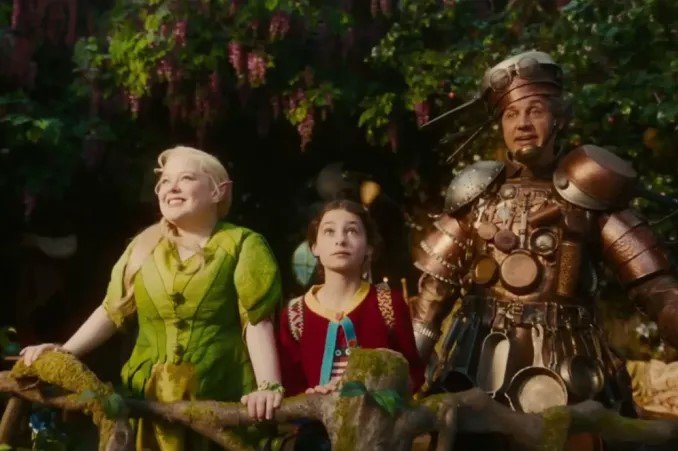
Very few films get approved for two sequels before the first has even been in cinemas for two months. But this adaptation of Enid Blyton’s wartime children’s fantasy didn’t just earn that vote of confidence less than two months after its release; it also got the renewal months before its global release.
Director Ben Gregor and writer Simon Farnaby bring the Faraway Tree series to the screen for the first time. This initial adaptation delivers a film that sheds the older details of its source material in favor of something with broader appeal, while still trying to hold onto the sense of wonder the books are known for.
At its heart, the film is about the joy of imagination and the magic of stepping away from screens. Whether audiences will find that idea visually and emotionally worth following for two more films is a different question entirely.
After Mom, Polly loses her corporate job and their London home, the Thompson family moves to a countryside barn. The parents try to convince their three children to minimize their use of devices so they can enjoy nature and a real childhood. Soon, the youngest daughter Fran finds a magical tree in the woods and gets her brother and sister to explore its changing worlds. With an eviction deadline coming fast and pressure for digital devices and city life they left behind coming from their children, the family must work together to save their new pasta sauce business.
What Works ✅
The Thompson Family Dynamic: The real reason the film works as well as it does has less to do with magic and more to do with the Thompson family. Claire Foy and Andrew Garfield play the parents, Polly and Tim Thompson, and together they avoid the usual clichés around on-screen parents while still being the ideal parents for any minors watching the film.
Garfield’s Tim is a stay-at-home dad who is relentlessly cheerful, openly dreamy, and, as the film’s opening scene makes clear, still in touch with his inner child. Foy’s Polly is the more grounded of the two, but she carries her own quiet, wide-eyed wonder, which keeps the film from falling into the tired daydreaming dad versus sensible mum pattern.
Their three children round out the dynamic well. Beth is independent and defensive, and she essentially serves as the story’s unintentional antagonist. Her stubborn, self-absorbed teenage logic often puts her at odds with the others, even when she means no harm. Joe provides most of the film’s laughs through a dry, unsuspecting wit that tends to land exactly when the scene needs it. Fran, the youngest, is still and observant in a way that draws genuine attention from those around her, and it is her quiet curiosity that opens the door to everything else.
The interplay between all five of them feels natural. Beth’s sarcasm brushes up against Tim’s insistence on keeping the mood light. Joe’s deadpan commentary on whatever is happening around him undercuts the sentiment just enough. Polly’s practical steadiness holds things together.
All of this creates a mix of friction and warmth, and the scenes where the family comes together carry a real ease to them. In a story built on a familiar premise, it is the characters and their particular chemistry that make it worth watching.
Bringing the Books Into the Modern Day: Enid Blyton’s Faraway Tree series was published between 1939 and 1951, and this adaptation does not attempt to treat that era as sacred.
Instead of transplanting the original setting to the screen, the film plants the story firmly in the present, folding in AI, smart technology, corporate privacy concerns, and the grip of digital devices as part of the world the children are escaping from.
What comes out of all these is a story about childhood imagination that also works as a story about digital detox. This makes the film feel relevant without relying on nostalgia.
Parents worried about screen time will recognise the concern immediately. Children who are growing up swiping through endless content will recognise the pull in the opposite direction.
What Doesn’t Work ❌
The Story’s Emotional Focus: The film’s central idea is the joy of a childhood spent in imagination instead of in front of a screen. But the story’s most emotionally striking moments consistently belong to the parents, while the children receive less of that emotional focus.
Tim and Polly’s inner lives, their unspoken dreams and the shame of falling behind expectations, take up a significant amount of the film’s emotional space. Even the arc of Moonface, the magical character who could have been a guide for the children’s own growth, ultimately ties back to the parents’ story instead of the children’s.
The children’s adventures in the magical lands are largely propelled by what is happening with the adults below. By the time the film reaches its resolution, it is Tim and Polly who have worked through their problems. The children’s connection to their inner child is more implied than shown.
For a film presented as a story for young audiences, this is a meaningful imbalance that results in a children’s adventure that feels more like a family redemption story.
The Scale and Look of the Magical Worlds: The film leans into practical set design instead of digital spectacle, which is a reasonable choice that makes the magical world feel physical and real. But the problem is not the approach to how the locations were made but the ambition within it.
Most of the magical lands that appear feel strangely ordinary. Save for the first land introduced, the others lack the kind of design detail that would make a child’s eyes widen.
The Land of Potions, for instance, is presented as a nighttime marketplace. It looks busy, but it looks like a market, not somewhere magical. There is no visible sense of wonder in how the space is used, and the children themselves do not react to these lands with anything that suggests they are more extraordinary than the VR headsets and smart devices they have left behind at home.
The magical creatures are draped in wool and fabric in ways that suggest costume rather than character, and their personalities do not leave the kind of impression that would make a child desperate to return.
Rebecca Ferguson’s Dame Snap: The film gives Dame Snap, played by Rebecca Ferguson, a brief but emphatic build-up as a figure of threat.
The children reach her land not through any logical development in the story but more or less by accident, and what they find there does not live up to anything that came before. The land itself lacks the impact the build-up suggests.
Despite the groundwork laid for her character she does not produce any real sense of danger or unease. Her presence does not connect in any meaningful way to the film’s central theme about imagination and childlike wonder. She neither opposes it nor pushes it forward.
The sequence could be removed from the film without much consequence, and it becomes difficult to see her as anything more than a way to add variety to the land selection.
⚖️ Verdict: 2.5/5
As the first ever adaptation of Enid Blyton’s Faraway Tree series, the film updates the source material for a modern audience.
The contemporary framing around digital detox is relevant, and the Thompson family is warm, funny, and fun to spend time with through both good and bad times. But the film drifts too far toward being a story for the whole family, leaving its younger audience less central, and it never really finds the visual imagination needed to convince today’s children that the magic of an enchanted tree can outshine a screen. Still, it is an enjoyable and charming watch, and a reasonable beginning to what could become a more expansive and ambitious series.
