

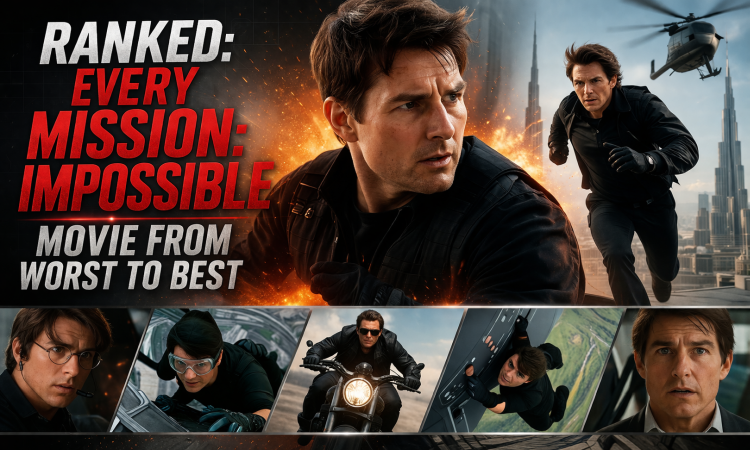
Every Mission: Impossible Movie Ranked from Worst to Best
Few action franchises have aged this well. What started in 1996 as a stylish and twist-heavy spy thriller gradually evolved into one of the most dependable blockbuster series in modern cinema. Over time, Mission: Impossible stopped being just another franchise and became a showcase for practical stunt work, high-stakes espionage, and Tom Cruise pushing action filmmaking to absurd new levels.
Some entries are colder and more cerebral. Others are bigger, louder, and more emotional. A few feel like transitional films between two different eras of the franchise. But together, they form one of the most impressive action runs Hollywood has produced.
Here is our updated ranking of every Mission: Impossible movie, from weakest to best.
8. Mission: Impossible II (2000)

There is no other film in this franchise quite like Mission: Impossible II, and that is both its greatest strength and its biggest problem.
John Woo turns the series into a full-blown operatic action movie, complete with slow-motion gunplay, dramatic face-offs, white doves, impossible motorcycle physics, and a version of Ethan Hunt that feels more like a mythic action hero than a spy. At times, the movie is undeniably entertaining simply because it commits so hard to its own excess.
But compared to the rest of the series, it feels disconnected from what Mission: Impossible later became. The plotting is thin, the romance is overemphasized, and the action often chases style at the expense of suspense. There are memorable moments, especially the knife stunt near Ethan’s eye, but the film never finds the balance between spectacle and tension that the best entries do.
Why it ranks here: Stylish and occasionally fun, but easily the most uneven and least refined film in the franchise.
7. Mission: Impossible III (2006)
Mission: Impossible III gave the franchise new energy after a long gap and pushed Ethan Hunt in a more personal direction. Instead of focusing only on global stakes, the film makes Ethan’s private life part of the story, which instantly gives the action more emotional weight.
Its biggest weapon is Philip Seymour Hoffman as Owen Davian, still one of the strongest villains in the entire series. He is calm, ruthless, and genuinely threatening in a way that few Mission: Impossible antagonists ever match. The Vatican sequence, the bridge attack, and the Shanghai run all work well, and the movie gives Ethan a level of vulnerability that helps the franchise grow.
What holds it back is that some of its filmmaking feels very tied to the mid-2000s. The pacing is aggressive, the editing is sometimes too hyperactive, and the Rabbit’s Foot mystery is more useful as momentum than as a satisfying story payoff.
Why it ranks here: A major step forward for the franchise emotionally, but not as polished or rewatchable as the higher-ranked films.
6. Mission: Impossible – The Final Reckoning (2025)
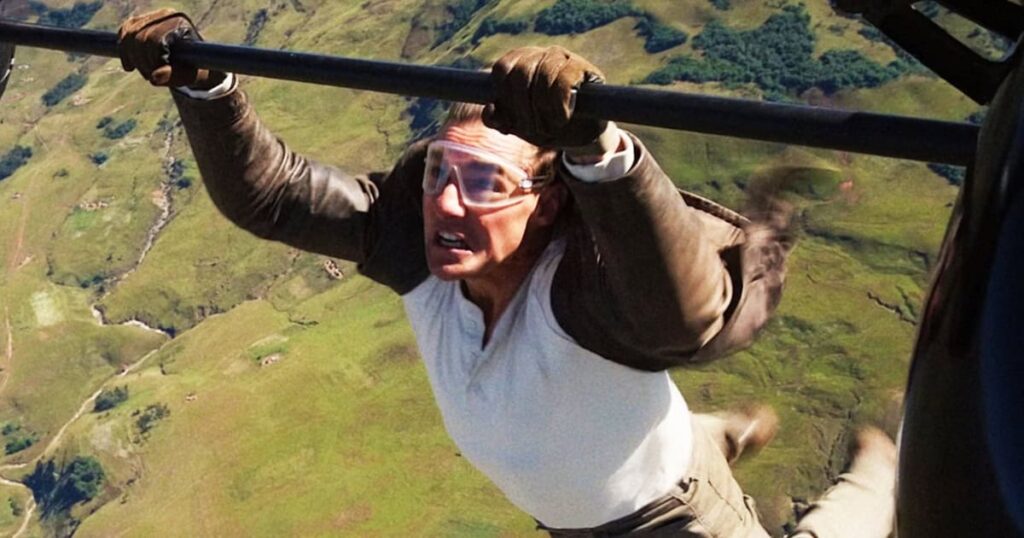
The Final Reckoning arrives with the difficult task of functioning as both a continuation and a payoff. It has to carry the weight of what came before, build on the Entity storyline, and still feel like a proper climax to the long Ethan Hunt run. That is a lot for any blockbuster to handle, and the film’s ambition is part of what makes it compelling.
What works best is the sense of scale and finality. The movie understands that audiences are not just showing up for another mission. They are showing up for the culmination of a franchise that has spent decades redefining itself. There is weight behind the action, and the film leans into the idea that Ethan Hunt is now confronting not just a threat, but the consequences of the choices that built this saga.
It does not rank higher only because some of the earlier top-tier entries remain tighter, cleaner, and more immediately rewatchable. But as a large-scale late-franchise chapter, it earns its place in the upper half.
Why it ranks here: Big, ambitious, and meaningful within the larger series, even if it is not quite as sharp as the franchise’s absolute best.
5. Mission: Impossible – Dead Reckoning Part One (2023)
Even as one of the lower entries in this ranking, Dead Reckoning Part One is still an impressive blockbuster. By this point, the franchise had already set such a high standard that “good” Mission: Impossible now means more ambition, more scale, and better stunt work than most action movies can offer at their peak.
The film’s central idea — a rogue AI known as the Entity — gives the story a more modern and unnerving threat than the series had tackled before. The Rome chase is excellent, the Venice section brings real tension, and the train finale delivers exactly the kind of escalating chaos fans expect from the franchise. The motorcycle cliff jump is also one of the defining stunt moments of the later Ethan Hunt era.
Its lower placement here is less about weakness and more about structure. Because it plays as half of a larger story, it lacks the complete, fully satisfying arc that makes the very best Mission: Impossible films feel so definitive.
Why it ranks here: Strong action, a timely villain, and several standout set pieces, but it feels slightly incomplete compared to the franchise’s best entries.
4. Mission: Impossible – Ghost Protocol (2011)
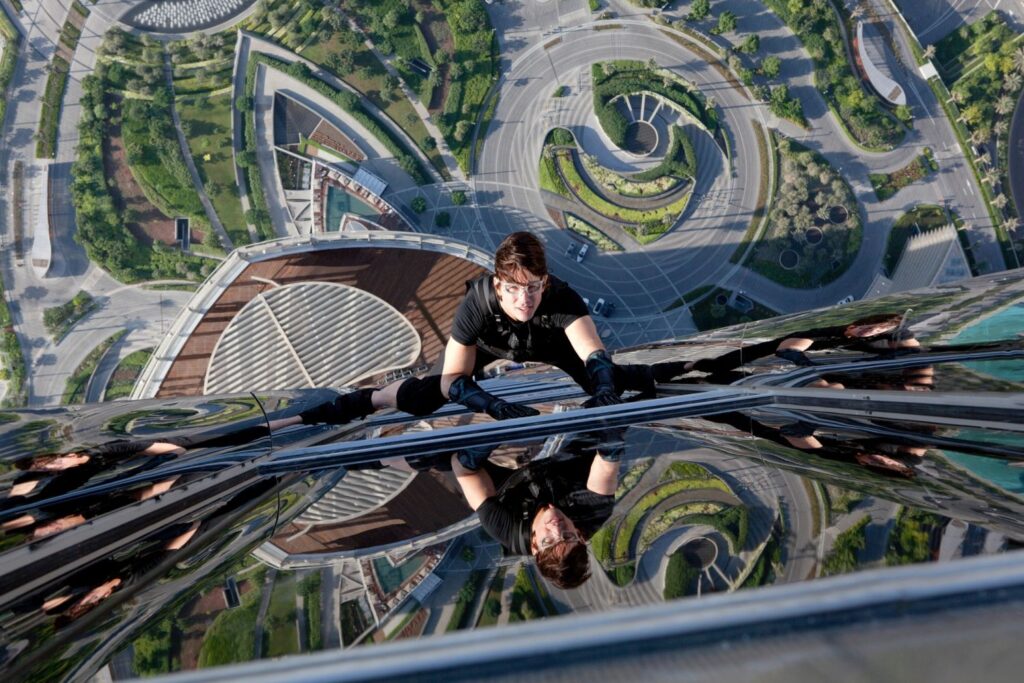
Ghost Protocol was the movie that made it clear Mission: Impossible had entered a new era. It is faster, more playful, and much more confident about turning Ethan Hunt into the center of gigantic practical spectacle.
The Burj Khalifa sequence remains one of the signature set pieces of the entire franchise. It is not just visually impressive. It is suspenseful in a way that perfectly captures what makes Mission: Impossible different from so many other action series: the stunts are massive, but they are also built around vulnerability and precision. You feel the risk.
The team dynamic improves dramatically here too. Simon Pegg gets more to do, Paula Patton adds real energy, and Jeremy Renner fits naturally into the ensemble. The villain may not be especially memorable, but the film’s rhythm, tone, and sheer entertainment value make it one of the franchise’s most important turning points.
Why it ranks here: The movie that fully modernized Mission: Impossible, even if some later entries refined the formula better.
3. Mission: Impossible (1996)
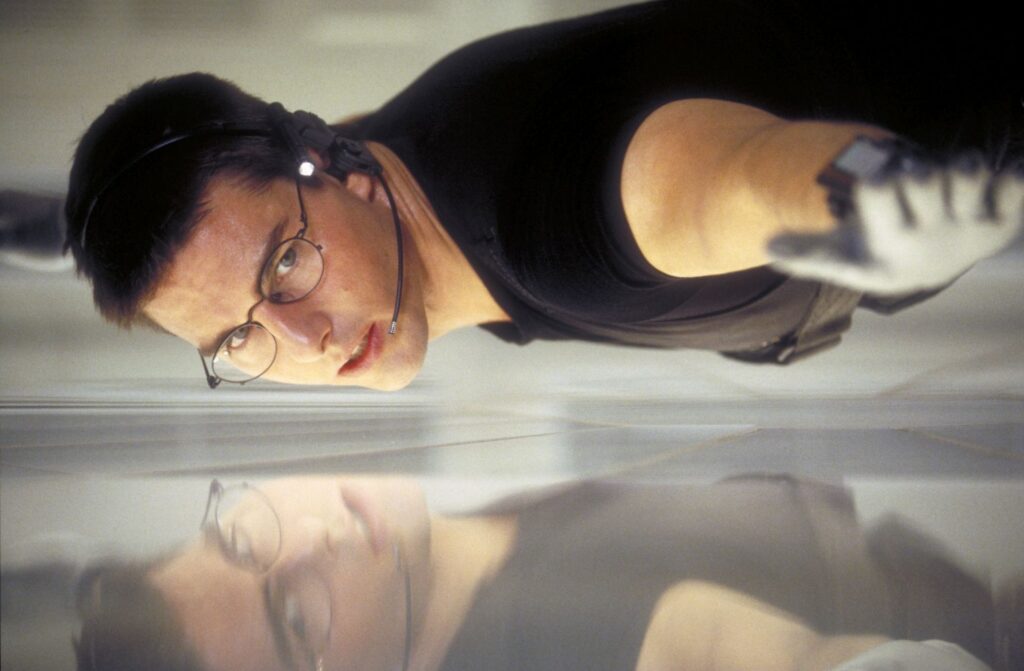
Brian De Palma’s original Mission: Impossible now lands much higher in this ranking, and it earns that spot for one major reason: nothing else in the franchise feels quite like it.
Before the series became synonymous with death-defying stunt work, it was a colder, sharper, more suspicious espionage thriller. The 1996 film is built on deception, paranoia, and shifting loyalties. It trusts atmosphere more than noise. The famous CIA vault break-in remains one of the best suspense sequences in franchise history, and the entire movie has a sleek, controlled intelligence that still stands out.
Yes, the plotting can be dense, and some viewers still find it more complicated than emotionally engaging. But revisiting it now, that complexity feels more like part of its identity than a flaw. It is the most purely “spy” movie of the whole franchise, and that alone gives it a special value that later entries never try to replicate.
Why it ranks here: A stylish, intelligent beginning with one of the franchise’s all-time great sequences and a tone no other entry has matched.
2. Mission: Impossible – Rogue Nation (2015)
If the original film established the spy DNA and Ghost Protocol reinvented the series, Rogue Nation perfected the modern formula. This is the point where Mission: Impossible feels completely confident in what it is: a precise mix of espionage, practical spectacle, slick pacing, and strong ensemble chemistry.
The film is stacked with high-level sequences. The airplane opening is instantly iconic. The Vienna opera scene is beautifully staged and full of tension. The underwater vault sequence is one of the most stressful scenes in the series. And the motorcycle chase keeps the energy high without ever feeling hollow.
It also introduces Ilsa Faust, one of the best characters the franchise ever added. Rebecca Ferguson gives the film a different kind of energy — mysterious, capable, and unpredictable without ever feeling like a side note to Ethan’s story. She becomes an immediate asset to the series.
Why it ranks here: Elegant, sharply paced, and packed with standout set pieces, Rogue Nation comes incredibly close to the top spot.
1. Mission: Impossible – Fallout (2018)
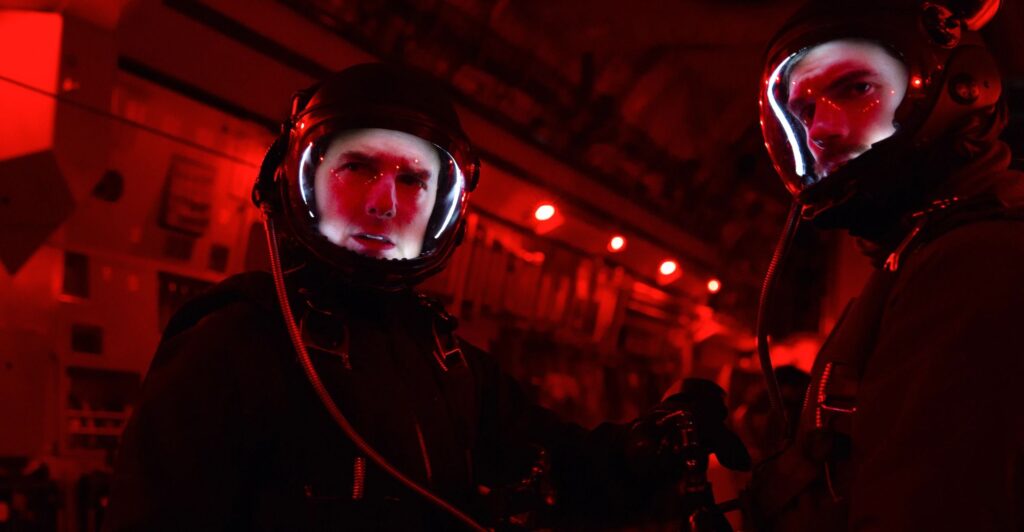
Fallout is still the peak.
This is the movie where everything clicks at the highest possible level. The action is bigger, but also cleaner. The emotional stakes are stronger. The pacing is relentless without feeling chaotic. And the stunt work is not just impressive — it is woven directly into the tension and character of the story.
The HALO jump, the bathroom fight, and the helicopter chase have all become signature moments not just for Mission: Impossible, but for modern action cinema more broadly. What makes Fallout special, though, is that it never feels like a collection of clips. It feels complete. Every sequence builds momentum, every choice sharpens Ethan Hunt’s character, and the movie understands exactly why this franchise works.
It is also one of the best examples of blockbuster filmmaking in the last decade: practical, propulsive, and emotionally grounded enough to matter.
Why it ranks first: It is the most complete, thrilling, and satisfying Mission: Impossible movie — the franchise at full power.
Final Ranking of the Mission: Impossible Movies
- Mission: Impossible – Fallout (2018)
- Mission: Impossible – Rogue Nation (2015)
- Mission: Impossible (1996)
- Mission: Impossible – Ghost Protocol (2011)
- Mission: Impossible – Dead Reckoning Part One (2023)
- Mission: Impossible – The Final Reckoning (2025)
- Mission: Impossible III (2006)
- Mission: Impossible II (2000)
Final Thoughts
Very few franchises improve this much over time. Even the weaker entries remain interesting because each film reflects a different version of what Mission: Impossible could be — paranoid spy thriller, operatic action showcase, emotional character piece, or large-scale stunt blockbuster.
But the best entries understand the balance. They combine spectacle with tension, character with momentum, and practical action with genuine cinematic craft. That is why the franchise has lasted so long — and why it still feels more alive than many newer series trying to copy it.
