

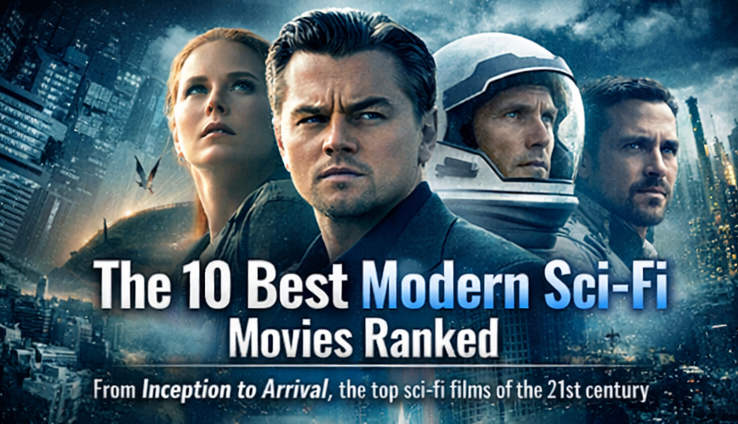
Science fiction has changed a lot in the 21st century. It is no longer just about spaceships, laser battles, or distant futures packed with shiny technology. Modern sci-fi has become more emotional, more philosophical, and often more grounded in real-world fears. It can be intimate and cerebral, or loud and spectacular, but the best entries all have one thing in common: they use big ideas to say something meaningful about humanity.
Some of these films reshaped the genre through visual innovation. Others proved that audiences were still hungry for thoughtful, original storytelling. Together, they helped define what modern science fiction looks like today.
Here are the 10 best modern sci-fi movies, ranked by ambition, execution, and long-term impact.
10. District 9 (2009)
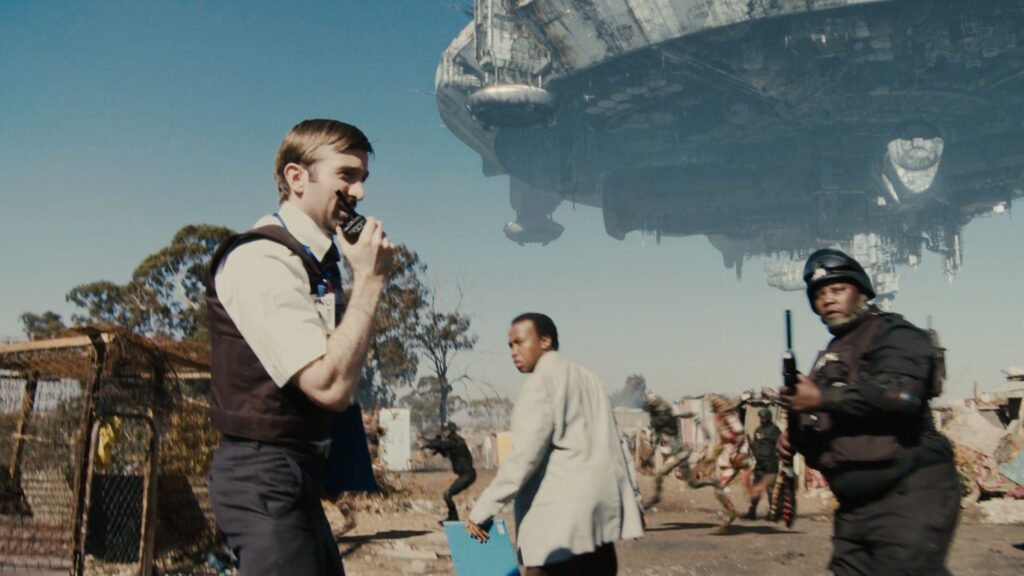
Neill Blomkamp’s District 9 remains one of the most striking sci-fi debuts of the modern era. Instead of giving audiences elegant alien visitors or world-ending invaders, the film presents extraterrestrials as marginalized refugees trapped in brutal living conditions on Earth.
Set in Johannesburg, the story follows Wikus, a bureaucrat whose life spirals out of control after exposure to alien biotechnology begins transforming him. What makes the movie so effective is its blend of gritty mockumentary realism and large-scale science fiction spectacle. The visual style makes the story feel immediate and uncomfortable, as if first contact were unfolding through raw news footage rather than polished blockbuster framing.
The result is sci-fi with political bite. District 9 proved that genre cinema could be socially pointed, visually inventive, and commercially effective at the same time.
9. Ex Machina (2014)
Alex Garland’s Ex Machina turned artificial intelligence into something far more unsettling than a simple machine uprising. Instead of treating AI as a source of explosive action, the film frames it as a psychological and moral trap.
The premise is deceptively simple: a young programmer is invited to a billionaire’s isolated estate to evaluate an advanced humanoid AI named Ava. But the movie quickly becomes a tense battle of manipulation, ego, and perception. The brilliance of Ex Machina lies in how quietly it operates. It does not overwhelm the viewer with scale. It narrows the focus and forces attention onto human weakness.
By making empathy itself feel dangerous, the film redefined AI-driven sci-fi for a more modern audience. It is sleek, controlled, and deeply unnerving.
8. Children of Men (2006)

Few dystopian films feel as immediate and immersive as Children of Men. Alfonso Cuarón imagines a future where humanity has become infertile, and society has collapsed into despair, violence, and authoritarian control. At the center is Theo, a disillusioned man who becomes responsible for protecting the first pregnant woman the world has seen in years.
The film is famous for its long takes, but the technical brilliance is only part of why it endures. Those sequences are not flashy for the sake of style. They pull the audience into the chaos with almost unbearable intimacy. The world of Children of Men does not feel futuristic in a conventional way. It feels frightening because it resembles a version of our own world pushed only slightly further into collapse.
It is one of the defining examples of sci-fi that works not through fantasy, but through realism.
7. Edge of Tomorrow (2014)
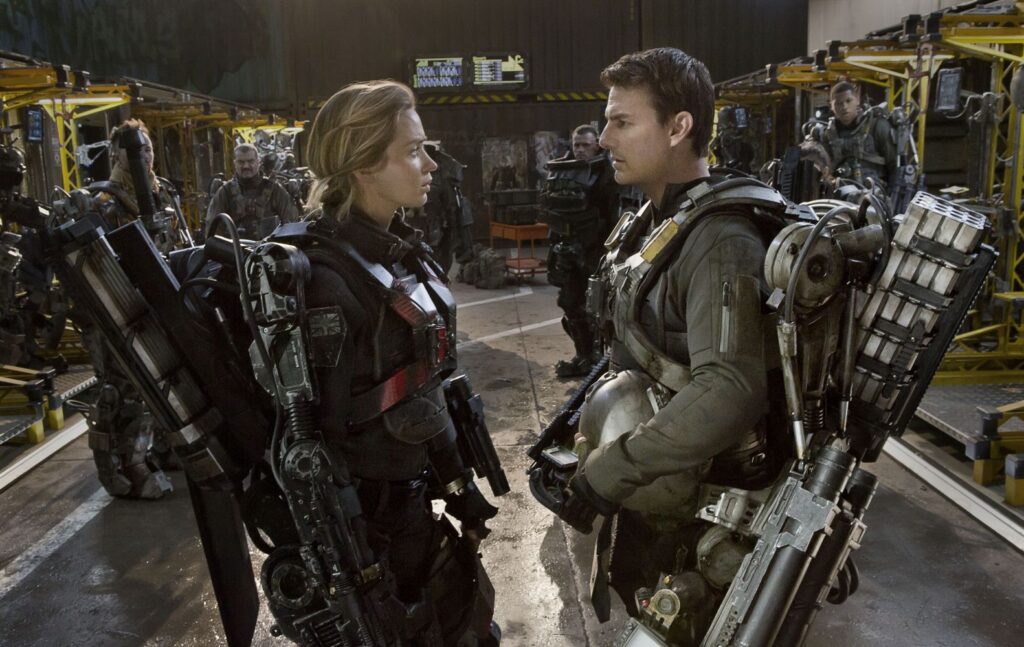
Edge of Tomorrow takes a familiar invasion setup and reinvents it through repetition. Tom Cruise plays a military public relations officer who gets trapped in a time loop during a war against alien forces. Every death resets the day, forcing him to learn through failure.
What makes the film stand out is how cleverly it translates game-like repetition into cinematic momentum. The story becomes a puzzle, and each reset deepens both the action and the character development. The film is also much funnier than its premise suggests, using Cruise’s repeated deaths and mounting frustration to keep the tone sharp and entertaining.
It is one of the rare modern blockbusters that feels both playful and precise, balancing spectacle with structure in a way many sci-fi action films never quite manage.
6. The Martian (2015)
Ridley Scott’s The Martian showed that science-driven sci-fi could thrive in the mainstream without needing a traditional villain. The story is built around survival, ingenuity, and one man’s effort to stay alive on Mars long enough to be rescued.
Matt Damon’s Mark Watney is a compelling lead because the movie lets intelligence be the engine of the drama. Instead of fighting monsters or armies, he fights distance, isolation, and the laws of physics. That approach gives the film a refreshing sense of optimism. The Martian is tense, but it never becomes cynical. It celebrates competence, collaboration, and scientific problem-solving.
That tone helped make it a major turning point for modern hard sci-fi. It proved that audiences were still excited by stories where science is not just background detail, but the main source of conflict and hope.
5. Blade Runner 2049 (2017)
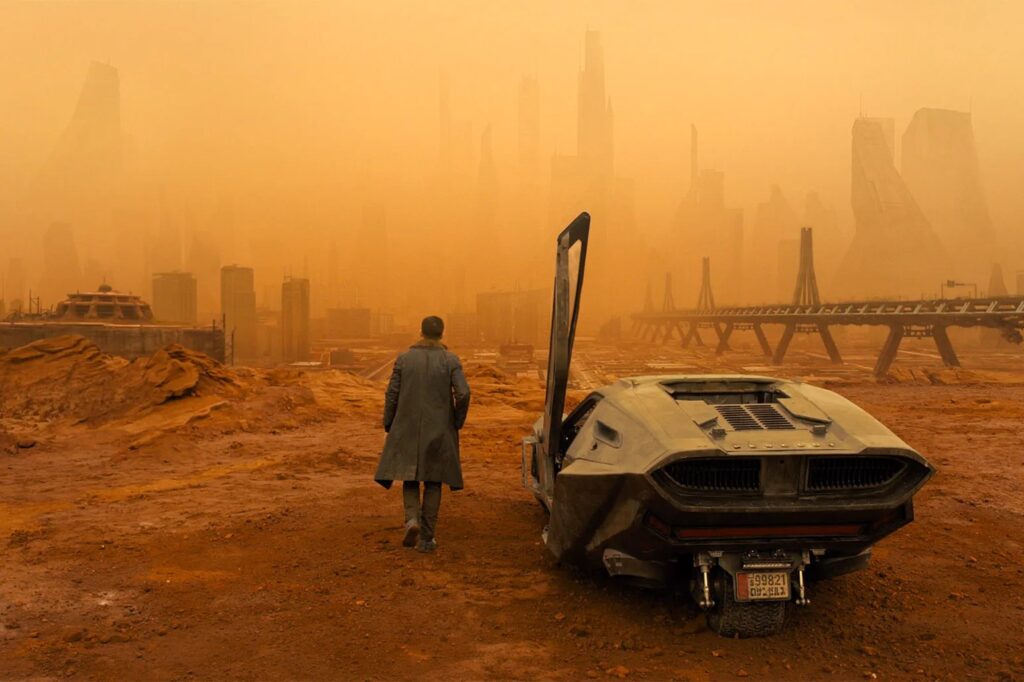
Expanding a classic is difficult. Expanding one of the most visually and philosophically influential sci-fi films ever made is even harder. Blade Runner 2049 somehow manages it.
Denis Villeneuve takes the world of the original and deepens it without simply imitating it. Ryan Gosling’s K is a replicant tasked with enforcing the system that controls beings like him, only to uncover a secret that threatens the entire social order. The film unfolds as a slow, haunting search for identity, memory, and meaning.
What makes Blade Runner 2049 exceptional is its confidence. It does not rush. It trusts mood, silence, and visual storytelling. Every frame feels carefully built, and the result is a sci-fi film that is both emotionally distant and deeply moving. It is less interested in answering its questions than in letting them linger.
That is exactly why it lasts.
4. Mad Max: Fury Road (2015)

There are action films, and then there is Mad Max: Fury Road.
George Miller returned to his wasteland universe and delivered one of the most exhilarating examples of visual storytelling in modern cinema. The plot is almost absurdly simple: escape, pursuit, reversal. But the execution is so precise and so relentless that the film becomes something much larger than a chase movie.
What makes Fury Road especially important within modern sci-fi is its commitment to physicality. In an era increasingly dominated by digital weightlessness, the film makes every impact feel real. The vehicles have mass, the stunts have danger, and the world feels lived in rather than rendered.
It is also a masterclass in clarity. Even amid chaos, the storytelling never becomes muddy. Every image pushes the narrative forward. Few films in any genre move with this kind of confidence.
3. Interstellar (2014)
Christopher Nolan’s Interstellar is one of the most ambitious mainstream sci-fi films of the century. It takes concepts like wormholes, time dilation, and black holes, then anchors them in something deeply personal: the pain of separation between a father and his daughter.
The film’s greatest achievement is how it fuses cosmic scale with emotional intimacy. It is enormous in scope, but it never loses sight of the human cost of exploration. Even when it dives into theoretical physics, it remains grounded in longing, grief, and hope.
Visually, it helped reestablish space as a place of awe rather than just danger. The imagery is grand, but the film’s lasting power comes from emotion. Interstellar is not simply about humanity reaching for the stars. It is about what those distances do to the people left behind.
That combination of science and feeling is what made it a defining modern sci-fi epic.
2. Arrival (2016)

With Arrival, Denis Villeneuve turned alien contact into something quiet, humane, and devastatingly emotional. Instead of framing first contact as a war story, the film asks what it means to truly understand another intelligence.
Amy Adams plays Louise Banks, a linguistics professor brought in to communicate with mysterious visitors after twelve alien ships appear across the globe. What follows is not a battle for survival in the usual sense, but a battle against fear, misunderstanding, and limited perception.
The film’s brilliance lies in its use of language as both a narrative tool and a philosophical idea. It suggests that communication can reshape not only diplomacy, but consciousness itself. That is a rare and powerful concept for a mainstream science fiction film to explore.
Arrival is proof that sci-fi can be cerebral, emotionally overwhelming, and visually elegant all at once.
1. Inception (2010)

If one modern sci-fi film truly defined the genre for mainstream audiences, it is Inception.
Christopher Nolan’s dream-heist thriller arrived with an original concept, a dense rule system, and blockbuster scale, then somehow turned all of it into a global phenomenon. Leonardo DiCaprio’s Dom Cobb is not exploring outer space or battling aliens. He is navigating the architecture of the mind itself, where memory, guilt, and desire become physical landscapes.
What makes Inception such a landmark is the confidence of its execution. It assumes the audience will keep up. It does not simplify its ideas to make them safer. At the same time, it delivers stunning imagery, practical set pieces, and emotional stakes strong enough to keep the complexity grounded.
It proved that original, idea-driven sci-fi could still dominate the cultural conversation. More than that, it helped define what audiences now expect from modern science fiction: intelligence, spectacle, and ambition working together at the highest level.
Final Ranking
- Inception (2010)
- Arrival (2016)
- Interstellar (2014)
- Mad Max: Fury Road (2015)
- Blade Runner 2049 (2017)
- The Martian (2015)
- Edge of Tomorrow (2014)
- Children of Men (2006)
- Ex Machina (2014)
- District 9 (2009)
Final Thoughts
Modern sci-fi works best when it does more than imagine the future. The strongest films in the genre use futuristic concepts to explore identity, language, fear, survival, memory, and human connection. That is why these movies still matter. They are not just clever or visually impressive. They say something.
Some redefine what blockbuster sci-fi can be. Others prove that the genre still has room for risk, subtlety, and original thought. But all ten helped shape the way modern science fiction looks and feels today.
