

The dinosaur film category has been largely defined by the creeping dread of Jurassic Park and the full-throttle action of the Jurassic World films. David Robert Mitchell’s The End of Oak Street does neither. Instead, it pulls the whole premise back down to earth and roots it in something more grounded.
Mitchell’s entry rests on a family and neighborhood that find themselves in the gruesome and inescapable terror of prehistoric nature. In some ways, it echoes the first Jurassic Park film in how it treats the dinosaurs as something terrifying rather than simply thrilling. But the context it places them in has never really been explored before.
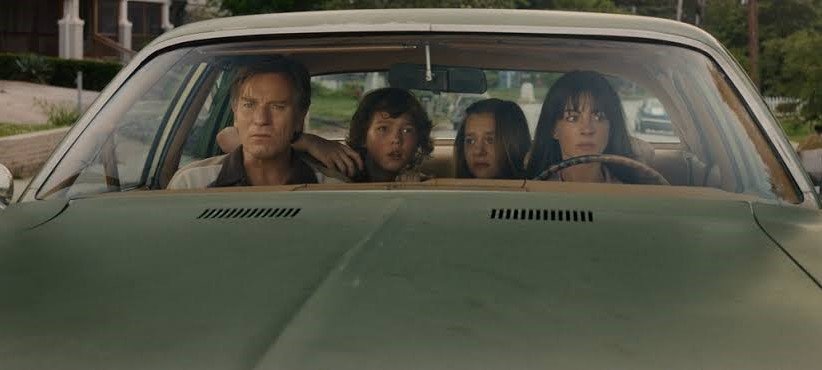
The film follows the Platt family whose quiet domestic breakdown is interrupted when a strange event strands their suburban neighborhood in a dinosaur-infested prehistoric wilderness.
Trapped without electricity or modern communication, the fracturing family must immediately unite to survive aggressive predators and find a way back to 1982
What Works ✅
The Setting Is the Film’s Selling Point: One of the smartest decisions the film makes is where and when it places its story. The End of Oak Street is set in the American suburbs of the 1980s, and that makes it distinctive. The era had a particular look that ranged from bright colors, big open front lawns, wide sloping streets, detached homes with yards that seemed designed for a sense of ease and safety.
Put dinosaurs in that world, and the wide spaces give them room to move, to hunt, to roam freely, and the camera takes full advantage of this. Shots capture them towering over the characters in a way that keeps building unease. The suburban lawn goes from being a shelter to being a trap of wide-open space with nowhere to hide and no way out.
The brightness of the era works in the film’s favor in a less obvious way. The warm, vivid look of the 80s gives the dinosaurs a wondrous yet dangerous sense of reality. Then, there’s the end of Oak Street itself, where the neighborhood’s edges meet the ancient forest around it. That physical boundary gives the film a strong and constant sense that civilization is thin, that help is not coming, and that what is out there does not care about any of the structures people have built around their lives.
Anne Hathaway Carries the Emotional Weight: The standout performance belongs to Anne Hathaway and her portrayal of Denise Platt, who is a stay-at-home suburban mother with one child almost out of the house and another not far behind.
She is married to a husband who is well-meaning but quietly disengaged from anything difficult. The characters are not written with much complexity on the page, but Hathaway does something with her performance that makes that matter less. Throughout much of the film, she looks a little worn out, like a woman who wants more from life than what her daily routine gives.
With Greg, there is a quiet frustration in her voice, but with her kids, she becomes more practical and direct, like a parent who simply deals with whatever needs to be dealt with. Hathaway’s performance makes Greg and the kids feel less like figures placed around her and more like actual people she has been with.
Direction, Cinematography, and Score Working Together: The film’s visual and sound choices do a lot to support its tone. The camera switches between two fairly distinct modes. In the quiet moments focused on characters, it uses calm close-ups. To highlight these moments better, it uses a style where one face sits sharp in the foreground while background detail is just as precise, giving ordinary domestic scenes a slightly dreamlike quality that makes them realistic and heightened.
In more intimate character moments, the framing is tighter and more personal. A scene where Greg and a dinosaur cautiously stalk each other on either side of a picket fence uses this approach well. The fence scene in particular, and a later one with Denise and a dinosaur, show how the film uses framing and editing together to make individual moments carry weight.
The sound design and score operate in a similar way. Rather than leaning heavily on songs from the period to signal the era, the film uses an orchestral score that moves between a bright, adventurous feeling that suits the setting and makes the high-energy and scary tone more perceivable.
But the most distinctive choice is what the film does with silence. It replaces the roars of dinosaurs with low grunts and the screams of neighbors heard from a distance. This occasional low, off-screen grunt only further sharpens the tone of the film and its effect.
The Diverse Look and Behavior of the Dinosaurs: Visually, these are not the dinosaurs audiences are used to. The dinosaurs are designed with bird-like qualities that reflect more recent scientific understanding of what these animals may have actually looked like.
What also helps is that the film shows the different dinosaurs with different behaviors and reactions. Some seem disoriented by their new environment, some seem to be almost indifferent to the people around them, while others are aggressive. They are also ones that are patient and stalk in ways that make them more dreadful than otherwise.
The film uses all of these elements together in its attack sequences: the setting, the camera, the sound, and the creature design, arranged with enough thought that the scariest moments genuinely earn their fear. The pace stays steady. It lets you sit inside both low- and high-energy scenes long enough to feel the sense that the people are out of their depth.
What Doesn’t Work ❌
Character Behaviour Affects Believability: For a film built around survival, the characters do a surprising number of things that make no sense given what they know is out there. Kids run off alone and shout in a neighborhood that is actively being hunted in. Adults charge at dinosaurs with household tools.
This hinders the film in a specific way. When the characters behave carelessly, the attacks that follow start to feel inevitable instead of being shocking and frightening. The tension that the film works so hard to build elsewhere gets let out through decisions that do not hold together. A significant part of the second act suffers from this and comes across as repetitive and less engaging.
The Final Twist Was Not Well Set Up: The film recovers in its final act with a twist that lands, and the ending is satisfying. But the twist hits less hard than it should because it did not do enough work with the characters to support the full emotional weight of what happens. The cast responds to it with real feeling, and although the twist works, the reaction to it is not as strong as it could have been because the characters were not drawn deeply enough at each other.
⚖️ Verdict: 4/5
The End of Oak Street is a satisfying film that brings something new to the dinosaur genre by grounding its premise in a specific time, a specific place, and real human stakes.
The 1980s suburban setting is both distinctive and effective, and the film uses it to build a kind of dread that feels real rather than artificial. It is the kind of film that will stand out within its genre and hold up over time. But everything the film was built to do could have hit harder with a little more care in the writing.
