

Paul Greengrass’s latest film, The Uprising, brings together two of Europe’s most memorable historical events: the Black Death and the Peasants’ Revolt of 1381. He fuses both with Robin Hood mythology.
The result is something genuinely unexpected. What initially looks like a straightforward take on the Peasants’ Revolt later reveals itself to be something quite different. By the time the connection between history and folklore is made, the revelation comes as a surprise. Nonetheless, it feels unfulfilling.
When it comes to the fusion of Hood’s tale and his Merry Men, Greengrass is less interested in the outlaws of the forest. Instead, he focuses on the real historical events that may have given birth to the legend in the first place.
For a turning point so deeply embedded in English history, the Peasants’ Revolt has never had a proper film adaptation. Greengrass’s version approaches that responsibility with both weight and style.
The film places its central fictional figure, a common farmer known as Ploughman, alongside real historical figures including John Ball, Wat Tyler, and King Richard II.
The name Ploughman is a reference to Piers Plowman, the earliest literary work to reference the Robin Hood folk tale. It was also used as a rallying cry during the actual Peasants’ Revolt.
Ploughman enters the story reeling from the deaths of his family caused by the plague that swept through the country. The disease has left those at the bottom with nothing, while those at the top keep demanding taxes and obedience. His grief turns into anger, and his anger accidentally inspires the rebellion. He follows it all the way to the gates of London to petition the king for a better life.
What Works ✅
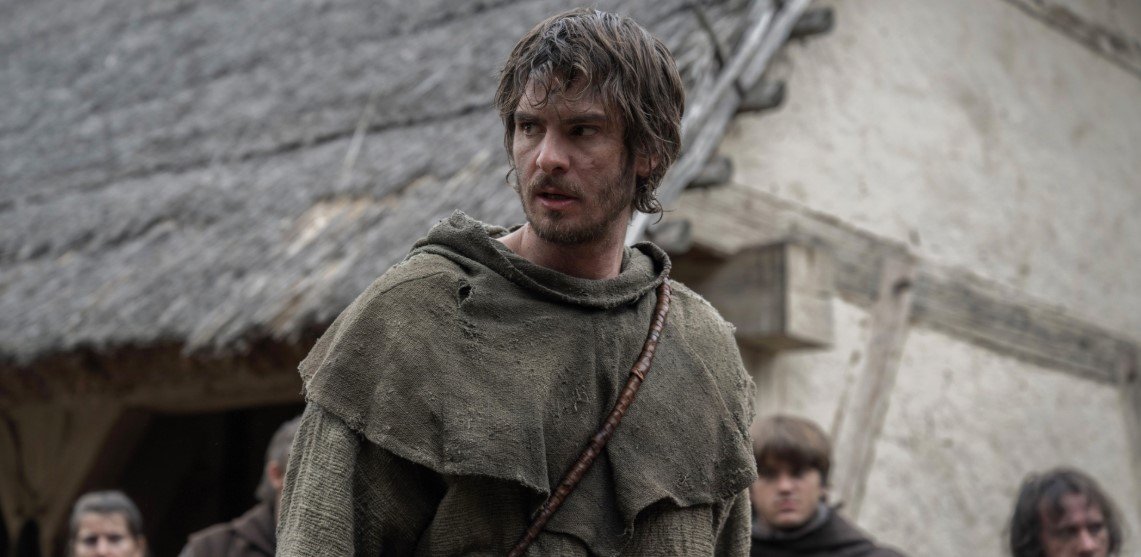
The Cast Disappears Into the Period: One of the film’s most effective choices is how it uses its ensemble. Andrew Garfield plays Ploughman, and while his character sets the whole story in motion, the film never keeps the camera fixed on him at the expense of everyone else. Jamie Bell, Cosmo Jarvis, and Thomasin McKenzie all step into the rebellion alongside him, each carrying a different aspect of the people’s grievances.
Jarvis represents the organised, institutional drive of the uprising. Garfield’s Ploughman stands for the ordinary man caught in something larger than himself. McKenzie’s Alyce is the face of raw anger at those in power. Bell carries the voice of faith and divine judgement.
On the other side, Stephen Dillane, Tom Hollander, and Katherine Waterston represent the court’s interests. Even actors with less screen time, like Sky Yang, get enough room to register.
This careful distribution of weight across the cast captures the film’s central sense of national unrest. No single character dominates the story to the point where everything else feels secondary. Because every section of the population has a recognizable face and a perceivable point of view, the film earns the scale it is reaching for. The uprising stops feeling like a plot device and starts feeling like something that concerns everybody.
The Story and Pacing Does Stall: Rather than opening with a slow prologue that builds toward the rebellion at arm’s length, the film throws itself directly into the conditions that caused it.
From the opening scenes, the grievances are already present, the anger is already visible, and the sense that something is about to break is immediate. As the story moves forward and the crowds begin to march, the film gradually reveals more about who the people are.
This approach keeps the film’s momentum steady throughout. Events follow one another with real consequence, and when the film does slow down, it does so around decisions that carry weight. The pacing does not abandon the viewer between scenes of crowd and chaos.
What Doesn’t Work ❌
The Characters Function as Symbols Rather Than People: Most of the characters function as stand-ins for particular viewpoints or social positions rather than as fully developed individuals. They represent a type of person from the period rather than existing as a specific person within it, which is the kind of thing you more often encounter in literature than in cinema.
The performers bring enough to make certain qualities stick: McKenzie’s enthusiastic impatience, Garfield’s heaviness, Bell’s fierce religious propaganda, Hollander’s careful manipulation, but these are impressions rather than personalities.
Garfield’s Ploughman is where this problem is most visible, because he is the character the camera returns to most often. Despite that central position, the film never gives him anything that makes him genuinely compelling to follow.
Katherine Waterston, who plays the King’s mother and takes up a notable amount of screen time, feels similarly disconnected from anything that actually moves the plot. She is present because her character logically would be, not because anything she does or decides changes the outcome in a meaningful way. The result is that most of the characters feel like ideas about people rather than people themselves.
A Cinematic Style That Works Against Itself: Cinematographer Pål Ulvik Rokseth shoots the film in a handheld, restless style clearly designed to produce the feeling of being on the ground with the marchers and inside the chaos of the revolt.
While the intention is sound, the problem is in the execution. The handheld movement does not calm down when the film moves into scenes that are quieter or more contained. The same jostling camera that makes sense during the march into London is still present in smaller, more intimate conversations, preventing them from feeling alive.
In the busiest scenes, the constant zooming and panning makes it difficult to settle on the performances and let them register properly. The style reads less like a camera aiding immersion into what is happening and more like a style being applied uniformly to everything. Rather than making the world feel real and immediate, it creates a slight sense of artificiality.
The Final Act That Abandons What the Film Built: The film’s most powerful scene comes when Ploughman is asked to speak to the crowd after John Ball and Wat Tyler have already addressed them in the language of philosophy and institutional ambition.
Ploughman speaks instead from the ground up, in plain words about suffering, and in doing so he gives voice to the specific, physical reality of what ordinary life in that period actually felt like. In this scene the film’s investment in gritty realism pays off most clearly.
The epilogue undoes much of that. Ploughman turns up dressed in green against the rich and powerful with a romanticised vigilante’s mercy in order to send a message. His choice in the epilogue reframes everything that came before it in a more comfortable, more conventional light.
The hardness and authenticity the film spent most of its runtime building is quietly softened at the last moment in favour of the legend. For a story that earned its weight by refusing to settle for myth, this ending reads as a step back from the very thing that made it worth watching.
⚖️ Verdict: 3/5
The Uprising is the first film to bring the Peasants’ Revolt to the screen, and for a significant portion of its runtime it presents a period that feels lived-in and a rebellion that feels dangerous. But in chasing realism through style, it makes its audience a bit removed from the events it is depicting.
History is treated with care, but the people inside that history are kept somewhat at arm’s length. What could have ultimately been a rare and valuable piece of historical cinema settles for something more familiar.
