

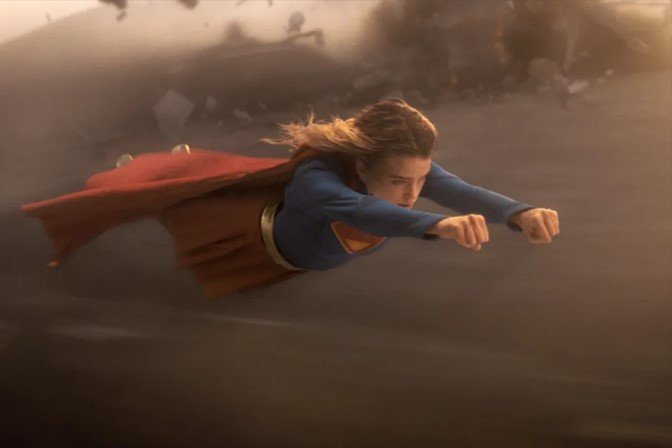
From Supergirl’s first appearance in Superman’s post-credits scene, slurring her words and saying exactly what she thought to her well-mannered, hope-filled cousin, it was clear she was a different kind of Kryptonian.
Where Clark finds good in everyone, Kara finds the truth. A film built around her does not disappoint on that front. What we get is a Kryptonian who discovers her own version of being human. Unlike her cousin who does this through hope and heroism, she does so by getting drunk, leaning into her vulnerability, and getting confronted with emotions she would rather avoid.
Milly Alcock’s cameo in Superman promised fun and flippancy, and the film delivers them. Whether it delivers on more than these in its 108 minutes is a complex question.
Regardless, it adds something different to DC’s live-action slate and brings a superhero story that is less interested in the cape and more in the person flaunting it.
The story follows Kara in the years after she watched the last remnants of Krypton die, along with her parents. Unwilling to build new connections, she moves across the cosmos in joyrides and through bars, trying to numb the weight of what she lost.
Things change when she meets Ruthye Marye Knoll, a young girl seeking revenge against the leader of a band of space pirates who murdered her father. Kara initially refuses to help, but after Krem crosses her path, she agrees to join Ruthye on her journey to find him.
As they travel across the lawless edges of space, Kara tries to stop Ruthye from losing herself to revenge while confronting the grief and isolation she has been running from.
What Works ✅
Krem’s Role as the Villain: Matthias Schoenaerts plays Krem with an attempt to make him interesting beyond what the script wanted him to be. His character is given no backstory and no moment of depth and is only written and designed to be simply repulsive.
The film ignores having a multi-dimensional villain because it is a story about Kara’s growth, and Krem exists to be an obstacle that forces it; still, Schoenaerts’ portrayal within his appearance makes Krem as disgusting and enjoyable as can be.
The character’s visual design does a lot of the work. Krem and his crew look gothic and grimy in layered black leather and metal.
He has a vaguely Eastern European accent that would read as an obvious movie-villain choice when used by someone with lesser acting ability. Here, he mixes it with a raspy growl and playful demeanor. The naturalness Schoenaerts brings to it makes it feel lived-in enough that you accept it without thinking too hard about it.
A Visual Language That Matches the Character: The film’s visual world is built around dust, poverty, and the worn textures of civilizations that exist on the darker corners of the cosmos.
The design of the settings captures the kinds of places where bounty hunters drink and predators operate. This is the environment that Kara is placed in; places that are low on connection and anything that might remind her of what she lost.
Alcock is introduced in a bar, wearing a distressed T-shirt, sweaty and enthusiastically drunk. Her superhero suit is deliberately held back for most of the film, keeping her grounded in the ordinary grime of her surroundings.
The production design leans into a retro-futuristic aesthetic and alien creature designs whose appearance mimics the repellent biology of the real world.
This contrasts sharply with scenes with Superman and Kara’s past. Scenes involving Clark and Krypton are lit in white, blue, and snowy landscapes that are juxtaposed against Kara’s dim, cluttered, bleak palette. This visual juxtaposition makes the emotional difference between them clear.
What Doesn’t Work ❌
The Script is Derivative and Does Not Establish its Own: The film’s problem of originality started early and continued till the end. Several scenes appeared as if they were pulled from other films. Several fight sequences bear a close resemblance to the works of producer James Gunn, who was originally attached to direct. Over time, this similarity becomes a distraction rather than an influence.
The story’s central idea is a familiar one. It follows the impending loss of someone dying, and a flawed, reluctant figure trying to stop someone else from making a destructive choice they cannot be talked out of.
Krem is presented as villainous for the sole purpose of giving the film’s themes of trafficking and female agency something to push against. He has the accent of every movie bad guy who has ever held that role.
Lobo, played by Jason Momoa in a role fans had long anticipated, is fun but he does nothing substantial. His character is used as a kind of chaos-generating, crowd-pleasing side character who makes the ride more entertaining but leaves no trace on the story.
The dialogue is where the derivativeness becomes much harder to ignore. The jokes land flat because most of them feel like variations of exchanges that have appeared in other films already.
Owing to the main character, the film’s tone is witty. When the tone shifts to something more emotionally direct, it goes too far, too fast because there was no genuine and realistic groundwork for those moments.
The scenes feel less like parts of one continuous story and more like separate stops along the way. Each scene works well on its own, but there is not enough connection between them to make the story feel like it is naturally building toward its ending.
Kara and Ruthye’s Relationship: Milly Alcock’s performance of Kara is sharp and defensive. She carries an avoidant and witty attitude that is a survival mechanism. Alcock’s performance is unheroic, with a style that is messy.
Eve Ridley’s Ruthye is Kara’s is a counterpoint to Kara. She is blunt and impossible to shake off, but her character does not go beyond those qualities.
Ruthye is determined and grief-stricken, yet the film does not explore these. Her rigid attitude is present throughout, but the inner state that would make it meaningful is not explored.
The two of them together never really find a meeting point that feels dynamic. Many of their interactions stepped down to information sharing and empty sarcastic exchanges. They simply state their intentions, each irritating the other, without that irritation producing anything memorable.
The film shows us where both characters end up by the final act, and the changes are visible. However, what is not visible is how they got there.
We do not see them rub off on each other in ways that would explain those changes. We also do not see either of them arrive at those changes internally and independently.
⚖️Verdict 2.5/5
Supergirl: Woman of Tomorrow is filled with parts of an enjoyable genre. The lead character is presented with wit and edge. The relationship dynamic has a clear shape, the conflict is thematically ambitious, and the visual design is justifiable.
But the film puts these pieces together without a unique and strong centre. The inner lives of both main characters are treated as known knowledge instead of being expressed and experienced. Their arcs feel announced from the opening rather than being uncovered as the film moves forward.
For viewers who are not very familiar with the genre’s popular elements, it will be an entertaining film.
