

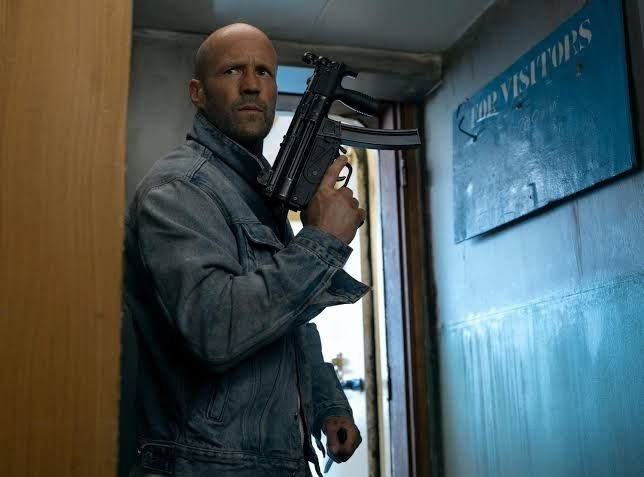
Mutiny is another entry in Jason Statham’s line of action thrillers, and it arrives with another iteration of the fearless, hardened persona he has made his own on screen.
After years of delivering bone-crunching and concussion-inducing films, Statham knows exactly what he does. The action star knows where he stands in the industry, and most importantly, who his audience is. It is a fitting and deliberate move, then, that he has launched his own production company, Punch Palace Productions, a name that tells you everything about who he is making films for.
Mutiny is their first film, directed by Jean-François Richet, and it follows the blueprint of its genre closely. Whether it delivers on the promise of that blueprint is another matter.
Cole Reed is a man scarred by experience. A former soldier and law enforcement officer who walked away from the system after watching justice get buried under bureaucracy and protocol. Now, he works as a private security operative, carrying his past quietly.
Soon Reed’s employer and friend is killed, and he finds himself framed for it. He sets out in an attempt to do justice and bring the truth to light. What begins as a personal reckoning pulls him into open water and into the centre of a large and dangerous criminal conspiracy.
What Works
The Container Ship as a Setting
The ship gives the story a contained, maze-like environment built from narrow corridors, stacked steel containers, and the inner structures of a working vessel most audiences will find new and unfamiliar.
Within that space, the familiar revenge narrative finds a fresh surface to play out on. The audience gets to watch characters move through and fight within a world that genuinely looks and feels like it belongs to itself.
The maritime environment also reshapes the action sequences in ways that standard locations never could. Fights break out on cabin staircases. The camera captures struggles from directly overhead as characters clash in the gaps between towering containers. A death arrives by harpoon, and another happens by padlock, with a figure left hanging from a suspended platform by the ship’s outer structure. The setting does not just provide a backdrop. It actively shapes how the violence is staged and where it can go.
Good Camera Work
The camera work in the film’s opening stretch does exactly what it needs to do to establish tone and character.
In the earlier, character-focused portions of the film, the camera moves in wide, flowing motion around the figures, with close-ups used sparingly and intentionally.
As the action takes over in the later sections, that balance is inverted. The close-ups become dominant, and the sweeping movements are pulled back, giving the two halves of the film a distinct visual texture.
There is one particularly effective thread in how the camera and sound work together to communicate something about Reed himself. The way both elements frame his alertness, the way he scans a room, processes a space, and notices what others do not. This registers him as a man whose instincts have been sharpened by years of taking responsibility for other people’s safety. Instead of explaining it through dialogue, the camera shows it.
A Sound Design that Delivers
The score and sound design are consistent contributors throughout. None of them fades into the background. The score lifts scenes that might otherwise feel flat, giving them a resonance they would not reach on their own.
The sound design is also attentive, from the crunch of impact on bone to the sharp, brief sound of a blade finding its target. It also uses silences and muffled tones, placing them at specific moments to keep the film grounded and human, as though the sounds of an actual, lived-in environment have been allowed alongside the genre and the way it works.
What Doesn’t Work
Unsatisfying Action Sequences
The fights are too brief to land with real weight. Apart from a handful of striking kills, they do not deliver the necessary tension that a film of this type promises. The first and final confrontations are the only sequences that carry the heft the film has been pointing toward.
Early on, it was established that the men Reed would ultimately fight are ex-military, seasoned, and dangerous. The suggestion is that this will be a challenge worthy of everything he brings. That promise disappears almost immediately. Instead of building fear and respect for Reed, the early ease with which he dispatches the most capable figures leads to a decline of the film’s action.
A Protagonist Without a Firm Presence
Reed is present in every section of the film, but he rarely feels like the centre of it. He moves through scenes and takes actions that are logical within the genre.
Statham delivers his lines in a low, guarded tone that suggests he is a man keeping something compressed beneath the surface, but the film stays that way.
His motivation for what he is pursuing does not feel understandable. To sort this out, an expository sequence near the start of the third act attempts to ignite the punishing stretch of retribution that would follow. That sequence relies on two earlier information drops. One was delivered to hype Reed, and another played out over a chess game. But the film doesn’t have Reed respond in a way that makes them land.
Angie Ellis (Annabelle Wallis) ends up carrying far more weight than the story seems to intend. Her character has something real at stake, which is communicated with more striking reactions.
Reed’s inner reckoning is buried beneath a stoic expression that reads more like blankness. There is no intensity or sense of calculated danger behind it.
Imbalanced Pacing
The film opens at a measured pace, settling its characters and establishing its world to build up stakes before the violence. The problem is that the film never meaningfully departs from that pace.
It generates short, isolated bursts of intensity and then returns to sequences of characters moving through the ship. The scenes in between fights carry little tension and do not visibly advance the story’s stakes or relationships. Another is a subplot that is introduced but contributes nothing to the film’s resolution.
⚖️Final Review: 2/5
Mutiny will do what it needs to do for audiences who show up specifically for this kind of film. The maritime setting gives the action a genuine freshness, the fighting exchanges have their moments, and the supporting characters stay largely out of the way.
For anyone outside Statham’s committed fanbase, the film doesn’t present anything new to the genre, and ignores several distinctive threads it sets up. The film stays safely inside the genre’s framework, keeping it from being anything more than a serviceable entry in a crowded field.
