

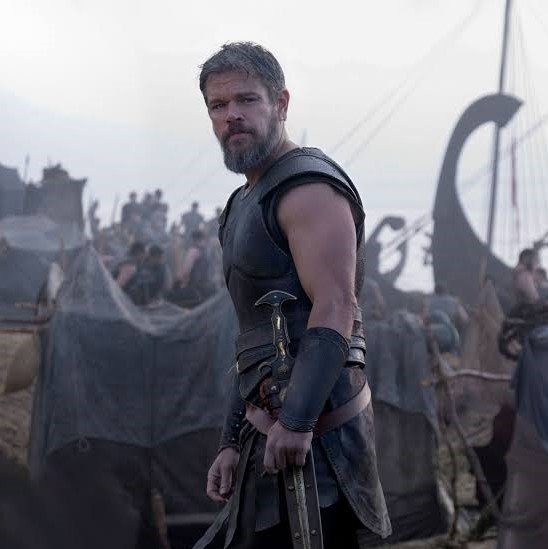
Christopher Nolan’s latest go at cinema, The Odyssey, strips Homer’s epic down to its core, removing the ornate poetic and mythic layers that once carried the poem’s message to ancient audiences. What replaces them is a combination of elements native to that ancient world and elements that belong to modern cinema, allowing the film to deliver the poem’s essential meaning as directly as possible.
The Odyssey is as much a journey of the mind and character as it is a journey home, and Nolan’s adaptation makes that clear without burying it in spectacle.
The story follows Odysseus, king of Ithaca, a weathered and battle-tested leader doing whatever it takes to survive a decade-long journey home after the fall of Troy. Back in Ithaca, his wife Penelope holds her ground against a growing court of suitors who have occupied the palace and consumed its resources under the assumption that Odysseus is dead while his son Telemachus watches helplessly.
As Odysseus moves from island to island, captivity to captivity, encounter to encounter, the film traces not just his physical ordeal but the gradual erosion and reconstruction of his identity, while back home, the longer he is gone, the more the world he is trying to return to threatens to disappear without him.
What Works ✅
The narrative structure: The film uses a non-linear narrative approach that gives an effect of making the world feel lived in rather than narrated.
Events separated by years and entire storylines are placed out of chronological order. The scenes are arranged in a way that follows the questions and curiosity naturally arising from the interactions in each scene, resulting in an actively immersive experience.
Rather than watching a story unfold from a distance, you are pulled inside it and experience it as the characters do. More importantly, the execution makes it feel as though the story could not have been told any other way.
Powerful worldbuilding: The world of the film looks built, not designed. The props, the ships, the armor, the architecture, all of it appears to have been made natively for a civilization that was genuinely living and building, rather than reconstructed for a movie.
The differences between Greek and Trojan armor communicate their distinct geographies, with each design carrying a visual character that blends subtly into the colors and landscapes of its surroundings. One that stands out is the wholly amour-clad visual depiction of the Laestrygonians, which captures their sturdy, defensive, and xenophobic character. There is none of the crude visual shorthand that often marks films set in the ancient world. Everything looks intentional, intricate, durable but nonetheless weathered.
What anchors the world further is its internal code of behavior. The film quietly establishes an ethos reminiscent of the ancient Greek principle of Xenia, expressed through a phrase that captures the moral weight of a world where the line between mortal and divine is genuinely uncertain. You treat everyone with dignity, because in a world where gods move among men, the stranger at your door may not be who they appear to be.
Beyond adding it in dialogue, this ethos grounds the direction of the film; it is communicated through behavior, through restraint, through the choices characters make when the code is honored and when it is violated.
Odysseus deliberately keeps his son out of his violent vengeance, knowing the consequences that follow such an act, a consequence he will later choose to fulfill himself. Polybus’ altercation with Odysseus’ son shows what happens when you cross over to the other side of that restraint, mirroring the action that incited the conflict on which the center of the story rests. These interactions and others are placed far apart but read as part of the same moral fabric.
Strong Ensemble and The Charismatic Performances of The Cast: Rather than building the film around one or two central performances, the film distributes attention across its ensemble. Every character has their own stake and take an active role in advancing the story. Telemachus is a young adult in body but a boy in manner, and Tom Holland carries him with a boyishness and naivety that communicates exactly what it means to grow up without a father who is also a king.
Anne Hathaway and John Leguizamo both deliver performances with clear emotional depth. Their expressions of calm, sneers, and outbursts show the behavioral and reactive detail that carries inner lives and identities shaped by time and pressure.
Matt Damon’s approach to Odysseus is the most distinctive. He does not play him as an idealized hero with curated grandeur and romanticized flaws. He plays him as a real man surrounded by real people, humbled and worn, someone who has simply lived for decades under conditions rather than someone who has been made older and wiser by a narrative. Himesh Patel’s portrayal of Eurylochus follows suit; the sense of him being Odysseus’ “first mate” does not come from him playing the part, but from simply being it, as level-headed as possible.
Grounding myth in reality: The film takes a grounded approach to myth and fantasy, exemplified in Odysseus’ interaction with his patron deity; here the gods appear as extensions of the characters’ own faith rather than as literal intervening forces.
Sorcery, whether by living or dead humans, requires active physical and ritualistic participation alongside its supernatural element. The story’s famed Cyclops is presented with visual details that suggest a biological condition, further grounding a world that is magical yet governed by recognizably human realities. Odysseus’ years of captivity are reshaped as an effect of substance abuse, among other reasons, rather than some sudden, convenient burst of magic.
At the film’s conclusion, rather than Athena striking down the suitors’ vengeful families as Homer writes, resolution comes through the world’s own laws and Odysseus’ choice, reflecting his transformation much as Homer intended, though by a different path.
The supernatural and mythic elements are never dismissed, but they are always given a parallel reading that keeps the world consistent and the story credible.
Where It Falls Short ❌
Awkward pacing all-round: Every scene and every exchange is tightly tied to the story’s forward movement, and it is done in a way that makes it as though the first and second acts are rushing toward the third. This leaves the characters with very little space to feel human, and the film begins to feel like a sequence of connected scenes rather than the interactions of actual people living in a world.
By the time the pacing opens up and the script gives characters space to breathe, the film is already in its third act. The single scene across the climactic run that carries genuine emotional weight is the moment Telemachus’ recognition of Odysseus. That moment works, but it works almost entirely on the strength of the audience’s background knowledge of what has been absent from both their lives, not from the emotional groundwork the film actually laid. It is effective not because of what came before, but despite it.
The third act is built as a crescendo, but the elements needed to make it land, especially the accumulated care for characters through moments of genuine human texture, were not given enough space or time to develop in the dialogue-heavy acts before it. As a result, the conclusion arrives without the emotional weight it reaches for. Although the story reaches a natural conclusion, it feels like something is still supposed to come after it because the preceding acts gave the ending little to land on beyond the information we were given.
Distributing weight across an ensemble cast while racing through the narrative means the very human interactions the film depends on never fully accumulate. While the approach is right, the pacing does not serve it.
⚖️ Final Verdict: 4.5/5
The Odyssey is an epic film with the visuals, action, and adventure to match its scale. What makes it genuinely rare is that it uses those visuals as background, as evidence of a world that is real and functioning, rather than as the main event.
That choice subverts the mythic grandeur the genre usually relies on and replaces it with something rawer: a struggle between people and the world they are living in, the world shaping around them and by them. In doing so, it honors the myth and the divine not as literal forces but as dimensions of faith, psychology, and character, following its source material into its actual subject rather than just its surface.
